I had always intended on following up on this previous post about the communal catharsis of destroying a Piano with an interview featuring Amy Kazymerchyk, the person who organized RECITAL at her home. In the process of interviewing her, many more amazing and inspiring tangents and connections emerged. As it is, the interview alone was much more than I expected. Without further ado, here is that conversation, an interview conducted by email, along with photos of the event taken by Aja Rose Bond (but don't be surprised if this topic comes up again)...
Gabriel: For context sake, describe "Recital" including who participated, how they participated and how the event was structured.
Amy: Recital came out of a conversation between myself and Frederick Brummer, a local organizer and sound artist. I had seen a piece he had made at the Surrey Art Gallery in which he took mechanical parts of different instruments to make a new sound machine. These included the turn table of a record player, piano key mallets, neck and frets of a guitar, bells etc. Part of what I loved about the sound machine was that the piano mallet (which is made of felt) ran along the turn table as it spun. The friction ground down the mallet and it slowly disintegrated into tracks of white dust. I loved this layering of the metamorphosis of the materials and use function of the parts. I suppose its a breaking down or dissecting of functionality that eventually renders them as pure material form.
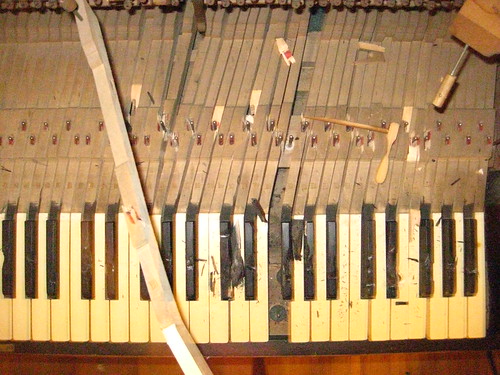
At the point when I decided to 'destroy' the piano, it was about a note and a half flat and completely untunable. The pegs were in soft wood and wouldn't hold, the bridge was cracked and poorly glued in multiple places and the sound board was also cracked. A few of the keys didn't work and the mallets were off-centered so multiple notes played at once. I was really into learning classical music including Satie and Bach at the time and i was frustrated with not being able to really feel and absorb the music because i wasn't hearing it right. Perhaps it speaks to my conservatism, but I realized that it wasn't the right piano for me. But I could still hear the beauty and resonance in its tones, and I knew that my experimental sound artist friends would be really into them as well. When I ran it by a few people everyone seemed really excited about taking parts of the piano for their practice. It just naturally evolved from there that if artists were going to take parts of it for their practice, then the 'taking' should be part of their practice as well.

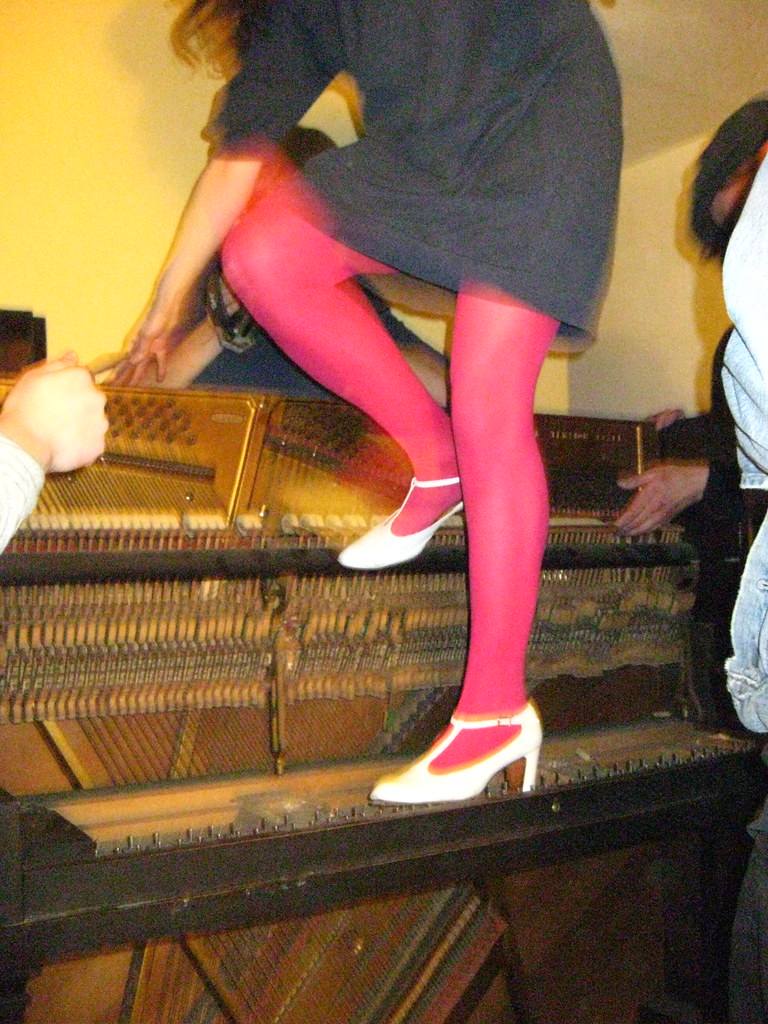
Frederick and I put out an open call to sound artists and musicians and about 5 people responded with interest. A few people had a fixed idea of what they wanted to do, and some people just wanted to come and participate on a more spontaneous level. People's intentions ranged from wanting to do quiet 'musical' performances to just smashing the shit of the thing and tearing at it with chainsaws. Some people came who also just contributed to unscrewing parts, ripping out keys, investigating the guts and just witnessing. We didn't make a set list until everyone arrived, and then we just figured out what order made sense (depending on how much of the piano needing to be in tact to make it happen.) Once it started it kind of felt like being in a trance. Time kind of stopped and it was like the room became its own kind of dimension. I'm not sure that anyone really 'knew' how to take apart a piano - but it became intuitive and then before we knew it it was in shreds and tatters and the iron sound board was being launched over the balcony onto the front lawn. It was completely unscripted and undirected- so the tension, energy, process and procedure of the destruction was completely spontaneous and the sum of everyone's contribution who participated.
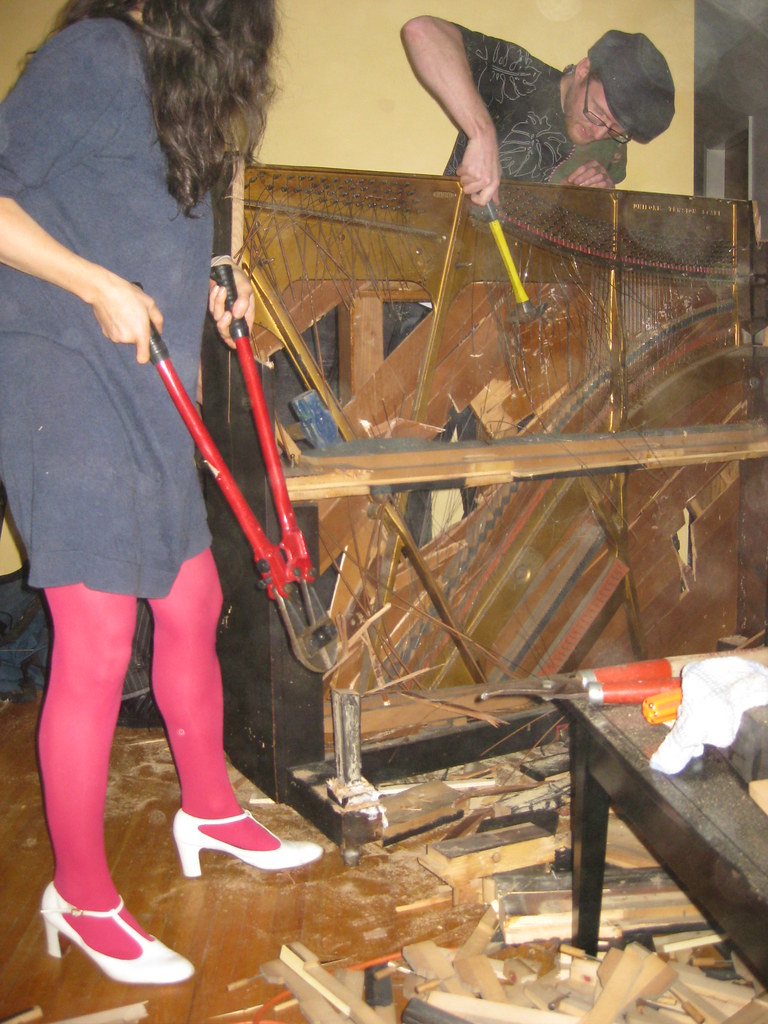
This is the list of people who participated: Karianne Blank, Aja Rose Bond, Sarah Buchanan, Frederick Brummer, Harold Donnelly, Amy Lynn Kazymerchyk, Willy LeMaitre, Nancy Lisik, Olo J. Milkman, Keenan O'Connor, Isla Roos, Kristen Roos, Harlan Shore, Andrew Short, Kika Thorne.
[Here is an audio recording of Frederick Brummer and Keenan O'Connor's performance...]
G: I see the act of destroying a piano as having this resonance beyond a nihilistic tearing apart of something beautiful, but rather a collective deconstruction of the commodity fetish. We find a greater utility in the deconstruction of the Piano than in its preservation at all costs. It's then liberating because we have done away with concerns of value related to the cost of the object and instead seek only its sensual value. Is this true? Was this true at Recital? Would this have been true if the Piano wasn't permanently out of tune?
A: Actually Its really important to me to preserve commodities/utilities/objects. I tried really hard to work out how to preserve the piano. I had a really astute piano tuner and then a piano technician come in to appraise it. The piano was 80 years old. It had an iron sound board and was screwed together by hand. It had ivory keys. I think the desire to want to destroy or throw out objects is more attached to commodity fetish. To me, being careful with objects; adopting, hunting down, or rescuing quality materials and items; fixing, repairing, mending broken objects; and finding creative ways to reinvent an objects use is counter-capitalist. If I could have tuned the piano I would have, and I would have paid to move it to my new house- absolutely- no doubt about it.
I grew up like that as well. My mother taught piano out of our house for years and we moved the piano around, tuned it, and lent it to people when we couldn't have it with us. Even years later when I was 20 I rescued it from a storage locker and moved it to Galiano Island in the back of a 1970's Ford truck. It's still there at the film school in an old logging camp! Maybe it will be the site of the next Recital. I think its comes from growing up poor and working class. One doesn't take objects and their value for granted. To the same end, it would be tragic to me to just take the piano to the dump or let it rot. Even unceremoniously destroying it would seem like a waste of its spiritual value. Now, absolutely ever part will continue to serve a use. Almost all of the musical mechanics were taken by artists. All the wood is in my yard to be used for ceremonial bonfire when it dries out, and I'd like someone to take the iron harp for a sculpture or sound piece. Maybe they can even restring it!
G: What is the most beautiful part of the Piano? Who got that part after Recital?
A: I think the most beautiful part was the rack of piano hammers. Kristen Roos took that in perfect condition, with only the middle c hammer removed. That was part of Olo's performance. The first element of the piano that was disfigured was the muting of middle C.
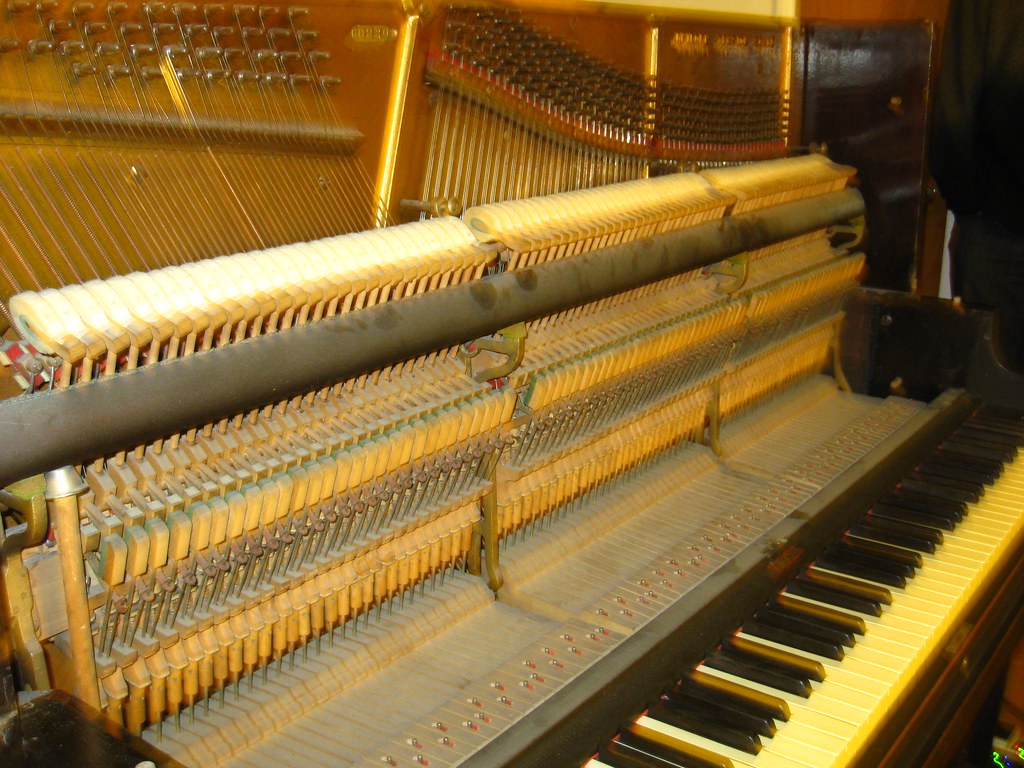
G: I am fascinated by Olo's action, the removing of middle C. It seems like the ultimate castration of the Piano. What was the emotional resonance of that particular performance for you?
A: I thought it was very witty and intelligent, but as a gesture it didn't have that much of an impact on me and definitely not an emotional resonance. The important part of the performance was that he was the first one to disrupt the form of the piano- and opened the flood gates for others to follow from there.
G: In Win-Win games there is a focus on the group play as a process of building relationships, community, trust or mutual understanding. In what way did or didn't Recital succeed as an example of Win-Win?
A: Yeah, there was a number of key moments in this process. The first was Frederick and I organizing something together. We had initiated a conversation about my interest in his work about a year ago when i saw his installation in Surrey. This project was definitely the fruition of that intention- which has established a new friendship for me in the city.
As well, FRONT Magazine really took an interest in the project. Karianne Blank, one of the Artistic Directors in the magazine was there to video tape the Recital, and Sarah Buchanan, one of the contributing writers was there to record it. We wanted to write something on the show for the most recent issue of FRONT which was focused on tools. The show didn't happen in time, but a video of the performance that I am editing as I write this will screen at the magazine's launch, and Frederick and Keenan will perform live as well. A reflective article on the show may appear in the next issue which is focused on social space. It was also just a really lovely way to spend an afternoon with people- sharing our ideas, our visions, and making something together. That's about as humbly Win-Win as it gets. Simply living together. But I mean consciously living.....and maybe realizing that art in its most essential purpose is also about consciously living and being in a dialogue with one's interiority, one's family and community, one's home space, and the materials and affects that we are blessed with.
G: I appreciated the links you made to Raphael Ortiz's work, as it really puts the act of destroying an object in a critical perspective. I feel like his work seems to suggest one of two possibilities - either the Piano is a stand in for we ourselves; a representation that speaks to what our own bodies experience in terms of the violence of society (in his case warfare, genocide, racism); OR the Piano is an effigy, a sacrificial lamb or wicker-man which we destroy so as to know our power to destroy without having to turn it in on ourselves. "The sacrificial process in art is one in which a symbolic act is performed with symbolic objects for symbolic purposes, initiated by the need to maintain unconscious integrity." Do you feel like this connects to the trance like state that you described experiencing at Recital?
A displacement and parallel process exists between man and the objects he makes. Man, like the objects he makes, is himself a result of transforming processes. It is therefore not difficult to comprehend how as a mattress or other man-made object [piano] is released from and transcends its logically determined form through destruction, an artist, led by associations and experiences resulting from his destruction of the man-made objects, is also released from and transcends his logical self.
I would say that the two observations you counted above are really the same thing. It's cathartic and it's symbolic. I don't really understand what Ortiz is talking about when he speaks of 'unconscious integrity'. However, earlier in the [Destructivism] manifesto Ortiz says
It's one's sense of death that needs the life-giving nourishment of ritual transcendence.What I read from these quotes is his readiness and willingness to practice death. We have such a fear in Anglo-christian North America about death, endings, failure, etc. and yet death is so essential- and paradoxically- even for life to exist. I think he's saying that we must practice death! We must create space, time, engagement and process [ritual] to practice death. We are socialized to practice life- to appraise creation and celebrate newness, birth, and beginnings- but we have little space for nourishing death. In practicing death the artist creates room for the essence of her ultimate potential to blossom. In practicing death on material forms, on art forms, and on processes, the artist is creating space for the death of herself to be released - like an effigy. There's definitely trance in that because it's terrifying. Even on subtle levels- to let one's material world or spiritual world die is de-stabilizing.
G: I know you have a deep appreciation for he Northwest and British Columbia in general. I wonder if Recital would have been something else if it had happened somewhere else, even somewhere with a generally similar economic system and ethnic make-up? Would it have been the same in NY? In San Francisco? In Toronto? etc.. To rephrase my question, do you feel like something specific to place shaped the experience of Recital? If I can get even more leading in my questioning, I wonder if you considered the tradition of Potlatch at all in this experience?
G: A standard I use to qualify a Win-Win game is its reproducibility. What I mean by that is it's ability to be replicated, albeit in a different form or context, by the participants. It is the element of Gift that makes the experience not just about witnessing, or laboring for the benefit of another artist, but in some way generative. What aspect of Recital is reproducible? What element would you or will you reproduce in future work? Obviously the Piano can never be returned to its original state, so I wouldn't consider that a possibility.
A: Two weeks later Frederick Brummer and Keenan O'Connor used recordings of RECITAL and piano keys in a performance at the western front for the FRONT magazine launch. They distorted the recording and complicated it with a percussive performance using the piano keys on the speakers that the recording was being played out of. That night we also screened the video documentation of RECITAL. So that definitely extended the event/activity into another environment and context; and developed its aesthetic into two different forms. I suppose this conversation you and I are having- and the frame of win win games and the online blog are also extensions and reproductions of the event.
As your blog illustrates, I'm not the first to be compelled to destroy a piano... so perhaps RECITAL isn't the origin from which reproducibility will evolve, but a stage of reproduction itself. I know that many of the piano's pieces were taken by artists who know doubt will incorporate them into their own performances, many of which i may never see or know about. I have a lot of the scrap wood at my house which I'm holding onto until it's warm and the wood can dry out. We're doing to take it to the beach and have a bonfire- a kind of extended ceremonial release of the piano's spirit. That would be its metaphysical reproduction. RECITAL has definitely led to a very unique experience of coping with commodity/ form/ material and consumption. I mean, if you can't afford to just throw something away then you don't have to deal with the responsibility of being a consumer. Once we make something its here- no matter in what form or location. Just because it goes to the dump doesn't mean its 'gone' it's just out of one's sight and perhaps consciousness. This project has made materiality very palpable to me. It's made me more conscious of what I bring into my life. It's ultimate recycling. It's beyond recycling. Maybe its beyond reproduction. Meta-Recycling, Meta-Reproduction.


